About Latitude Artist Community
Latitude Artist Community serves all people - with an emphasis on those thought by some to have a disability - by creating meaningful, inclusive community interactions which allow participating artists to contribute culturally and politically to the life of their community.
Showing posts with label Adult Day Habilitation. Show all posts
Thursday, September 2, 2010
Wednesday, August 4, 2010
Business Lexington: Latitude works to help blind and deaf artist find his place in art
Business Lexington, August 2010
by Kendra Ratliff
Lexington, KY - As he cleans off his worktable, artist Jessie Dunahoo, 78, feels around for any trace of dirt or plastic bag left behind. His balance is impeccable for his age, and as he maneuvers his body around the corners of the wooden table, one can't help but be impressed with his agility and patience, especially considering he is blind and deaf.
Although Dunahoo was born deaf and lost his sight long ago, his remaining senses are unfailing. Using creativity, imagination and a strong work ethic, Dunahoo has made a name for himself as a successful visual artist creating sculptures that are functional and beautiful.
For the past decade, Dunahoo has been a part of Latitude Artist Community, founded by Bruce Burris and Crystal Bader.
"He is his own guardian, and it's difficult to say that yes, he wanted to come here, but he did make it clear that he wanted to continue to make art. And when we started Latitude, we offered the invitation for him to come, and he did accept," said Bader.
Dunahoo spends three days a week in his studio, where he works independently, setting up, working and cleaning his space. Dunahoo typically works for six hours a day and will often work on different projects simultaneously, according to Bader.
"I do believe what he is creating is functional for him. Sometimes it is an ascetically pleasing sculpture or piece of work, like a quilt, but still that's functional. He has created housing that you can get into, he has created tents, and when he shows us how it's supposed to be used, it's obvious what it's supposed to do," said Bader.
Keeping that functional purpose in mind, Dunahoo is also resourceful, using recycled materials like plastic bags to create his art. Underneath his worktable, there are bags and boxes full of materials like shopping bags from various stores, empty plastic containers and thread. Dunahoo also has access to paper, paint, tools and many other supplies provided by Latitude.
Dunahoo uses needle and thread to stitch plastic bags together with uncanny precision to create whatever he feels compelled to do. "I have seen him use yarn as well," said Bader, who describes the various techniques Dunahoo uses when stitching bags together.
Dunahoo stitches one line at a time by using his legs or bagging up bricks to use as an anchor so he can spread out on the table. "He feels and searches around for structures to pin his work too," said Bader.
Dunahoo is always working. "He creates these installations constantly," said Burris. In June, Dunahoo created a rain slicker inspired by a rainy day. He spent about three studio days creating the rain jacket and when he finished he modeled the jacket to show how it worked, according to Burris.
Although Dunahoo's exact purpose for his work is unclear, it seems functionality is a priority.
"His mission is to create in a way that he is doing right now," said Burris. "His bedroom is organized with plastic bags hanging from the wall, instead of chests. They have pockets in them for storage."
Dunahoo's artistic creations not only have function, but there's a lot of passion behind the work.
"I think it's a passion for him because he's driven to do it; for what reason, we don't know, but he's definitely driven to do it, and if it wasn't a passion, he wouldn't be doing it," said Bader.
Dunahoo has had numerous installations and exhibits in the Lexington area, as well as a solo exhibit in 2008 at the Andrew Edlin Gallery in New York City.
Burris and Bader have been very cautious about selling Dunahoo's work, not because there hasn't been interest, but because Latitude doesn't try to push it.
"There would be no point in allowing him to exhibit if there wasn't potential to sell," said Burris. "But we're really working, and we have been over the past 12 years to just kind of get his space right."
Burris explained that there are other issues to consider with Dunahoo.
"Because he is supported in the way that he is, and though he is self-sufficient and can cut a path in the world in a marvelous way ... he doesn't have any real control or understanding of the art world beyond the creation," said Burris.
Latitude's focus has been to create a history and a legacy for Dunahoo. "We are really more interested in getting the writing that needs to be done on him, the documentation, the archiving of all of his work," said Burris, who feels that despite how old Dunahoo is, he has a lot of time to nurture the process.
Latitude has been trying to figure out where Dunahoo lives within the realm of art history. "Our thing has been to really place him within a historical context," said Burris.
Despite Dunahoo's dependence on different services and people, he is "his own unit," said Burris. Keeping that in mind, Latitude's primary objective is to put Dunahoo's work in a community environment, keeping it positive and exclusive in a way that brings attention to the work itself, as well as to the artist. In Dunahoo's case, those works of art are unique and meticulous creations that demonstrate how passion and dedication can bring out the best in an artist.
An Artist's Touch
Latitude works to help blind and deaf artist find his place in artby Kendra Ratliff
Lexington, KY - As he cleans off his worktable, artist Jessie Dunahoo, 78, feels around for any trace of dirt or plastic bag left behind. His balance is impeccable for his age, and as he maneuvers his body around the corners of the wooden table, one can't help but be impressed with his agility and patience, especially considering he is blind and deaf.
Although Dunahoo was born deaf and lost his sight long ago, his remaining senses are unfailing. Using creativity, imagination and a strong work ethic, Dunahoo has made a name for himself as a successful visual artist creating sculptures that are functional and beautiful.
For the past decade, Dunahoo has been a part of Latitude Artist Community, founded by Bruce Burris and Crystal Bader.
"He is his own guardian, and it's difficult to say that yes, he wanted to come here, but he did make it clear that he wanted to continue to make art. And when we started Latitude, we offered the invitation for him to come, and he did accept," said Bader.
Dunahoo spends three days a week in his studio, where he works independently, setting up, working and cleaning his space. Dunahoo typically works for six hours a day and will often work on different projects simultaneously, according to Bader.
"I do believe what he is creating is functional for him. Sometimes it is an ascetically pleasing sculpture or piece of work, like a quilt, but still that's functional. He has created housing that you can get into, he has created tents, and when he shows us how it's supposed to be used, it's obvious what it's supposed to do," said Bader.
Keeping that functional purpose in mind, Dunahoo is also resourceful, using recycled materials like plastic bags to create his art. Underneath his worktable, there are bags and boxes full of materials like shopping bags from various stores, empty plastic containers and thread. Dunahoo also has access to paper, paint, tools and many other supplies provided by Latitude.
Dunahoo uses needle and thread to stitch plastic bags together with uncanny precision to create whatever he feels compelled to do. "I have seen him use yarn as well," said Bader, who describes the various techniques Dunahoo uses when stitching bags together.
Dunahoo stitches one line at a time by using his legs or bagging up bricks to use as an anchor so he can spread out on the table. "He feels and searches around for structures to pin his work too," said Bader.
Dunahoo is always working. "He creates these installations constantly," said Burris. In June, Dunahoo created a rain slicker inspired by a rainy day. He spent about three studio days creating the rain jacket and when he finished he modeled the jacket to show how it worked, according to Burris.
Although Dunahoo's exact purpose for his work is unclear, it seems functionality is a priority.
"His mission is to create in a way that he is doing right now," said Burris. "His bedroom is organized with plastic bags hanging from the wall, instead of chests. They have pockets in them for storage."
Dunahoo's artistic creations not only have function, but there's a lot of passion behind the work.
"I think it's a passion for him because he's driven to do it; for what reason, we don't know, but he's definitely driven to do it, and if it wasn't a passion, he wouldn't be doing it," said Bader.
Dunahoo has had numerous installations and exhibits in the Lexington area, as well as a solo exhibit in 2008 at the Andrew Edlin Gallery in New York City.
Burris and Bader have been very cautious about selling Dunahoo's work, not because there hasn't been interest, but because Latitude doesn't try to push it.
"There would be no point in allowing him to exhibit if there wasn't potential to sell," said Burris. "But we're really working, and we have been over the past 12 years to just kind of get his space right."
Burris explained that there are other issues to consider with Dunahoo.
"Because he is supported in the way that he is, and though he is self-sufficient and can cut a path in the world in a marvelous way ... he doesn't have any real control or understanding of the art world beyond the creation," said Burris.
Latitude's focus has been to create a history and a legacy for Dunahoo. "We are really more interested in getting the writing that needs to be done on him, the documentation, the archiving of all of his work," said Burris, who feels that despite how old Dunahoo is, he has a lot of time to nurture the process.
Latitude has been trying to figure out where Dunahoo lives within the realm of art history. "Our thing has been to really place him within a historical context," said Burris.
Despite Dunahoo's dependence on different services and people, he is "his own unit," said Burris. Keeping that in mind, Latitude's primary objective is to put Dunahoo's work in a community environment, keeping it positive and exclusive in a way that brings attention to the work itself, as well as to the artist. In Dunahoo's case, those works of art are unique and meticulous creations that demonstrate how passion and dedication can bring out the best in an artist.
Artist Steve Pavey at Phantom Place Project Space (Latitude)
Latitude Artist Community Steve Pavey at Phantom Space Project Space (Latitude) until September 10
My art critically explores power & inequality at the nexus of politics, economics and religion committed to envisioning/embodying social change bent towards justice. My art utilizes money, flags, and bible...s in an effort to grapple with the issues Martin Luther King, Jr. called the three great problems of society - Materialism, Militarism, & Racism.
“I am convinced that if we are to get on the right side of the world revolution, we as a nation must undergo a radical revolution of values. We must rapidly begin the shift from a "thing-oriented" society to a "person-oriented" society. When machines and computers, profit motives and property rights are considered more important than people, the giant triplets of racism, materialism, and militarism are incapable of being conquered.”
Martin Luther King, Jr.
May 4, 1967 (one year before he was assassinated)
ARTIST STATEMENT - A REVOLUTION OF VALUE(S)
My art critically explores power & inequality at the nexus of politics, economics and religion committed to envisioning/embodying social change bent towards justice. My art utilizes money, flags, and bible...s in an effort to grapple with the issues Martin Luther King, Jr. called the three great problems of society - Materialism, Militarism, & Racism.
“I am convinced that if we are to get on the right side of the world revolution, we as a nation must undergo a radical revolution of values. We must rapidly begin the shift from a "thing-oriented" society to a "person-oriented" society. When machines and computers, profit motives and property rights are considered more important than people, the giant triplets of racism, materialism, and militarism are incapable of being conquered.”
Martin Luther King, Jr.
May 4, 1967 (one year before he was assassinated)
Tuesday, July 27, 2010
ADA Event in Lexington (Latitude)
LEXINGTON HERALD-LEADER - From left, Pamela Roark-Glisson, her husband John Glisson, Bruce Burris and Arthur Campbell addressed a crowd in front of about 15 feet of sidewalk blocked off by a roll of during a rally and celebration for the 20th anniversary of the Americans with Disabilities Act in front of the Lexington History Museum on Main St. in in Lexington, Ky., on Monday, July 26, 2010. About 25 people attended the rally including members of Latitude Arts Community and Freedom Riders from across the state. After the short rally in Lexington, many of the organizers headed to a larger rally in Frankfort. Photo by Pablo Alcala
Staff
Staff
Sunday, July 25, 2010
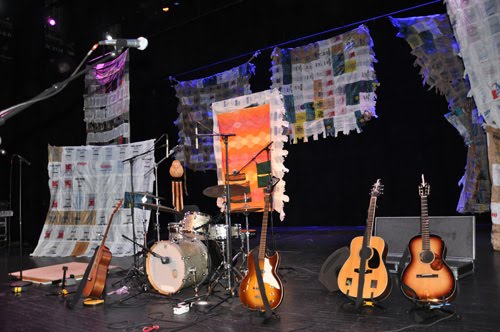
Ben Sollee concert with backdrop by Latitude artist Jessie Dunahoo
Ben Sollee/Appalachian Voices with Latitude artist Jessie Dunahoo
Institute 193 recently collaborated with Jim James, Ben Sollee and Daniel Martin Moore to install works by Jessie Dunahoo on stage at the opening of their Appalachian Voices US tour. Jessie Dunahoo is a blind and deaf artist who works at Lexington’s Latitude Artist Community and recently showed at 193’s space on North Limestone Street. Special thanks to Latitude Artist Community (specifically to Bruce Burris and Crystal Bader) The show took place on July 22, 2010 at the Lexington Opera House.
Our Lexington Sidewalk Survey Party was a huge success!
Our Lexington Sidewalk Survey Party was an enormous success. So many people showed up that Andrea ran out of survey forms! Thanks to all- especially to 1st District Councilperson Andrea James. Here are two great videos from this- the first from WTVQ features Latitude artist Melissa Amaral, and the second from the Lexington Herald-Leader features a nice interview with Councilperson Andrea James.
Tuesday, July 13, 2010
Three Lexington events in which you can participate Celebrating 20 years of the ADA (Americans with Disabilities Act)
Celebrate 20 years of the ADA!
Three Lexington events in which you can participate Celebrating 20 years of the ADA (Americans with Disabilities Act)
-----------------------------------------------------------------
Thursday July 22nd 5:30pm -8:00pm, Join 1st District Councilperson Andrea James for a Downtown Accessibility Survey Party!
Meet in the parking lot of Third Street Coffee (257 N. Limestone St.) at that time you will be given a map of downtown Lexington on which you may note specific accessibility problems you experience (special attention to sidewalks, crosswalks and outdoor café seating) and instructions for filling out your survey while navigating downtown as a pedestrian. Everyone is invited to help with this important survey- those of us who use wheelchairs and/or walkers are especially encouraged to participate.
Prior to the start of the survey (4:30pm-5:30pm) you can contribute to a performance piece “The Sidewalk Vanishes”
Sponsored by LFUCG’s Commission for Citizens with Disabilities
With Independence Place and Latitude Artist Community (PEAL)
----------------------------------------------------------------------
Monday July 26th, 9:00am- 9:30am Press Conference and a performance by Latitude’s Project Easy Access Lexington (PEAL) called “The Sidewalk Vanishes”
part of the 2010 ADA Freedom Relay & Celebration 215 West Main Street (in front of the Old Courthouse)
For more information contact: Independence Place, Inc. 824 E. Euclid Avenue, Ste 103 Lexington, Kentucky 40502 (859) 266-2807 or Toll Free (877) 266-2807
-------------------------------------------
Monday August 2nd 11am -2pm Latitude Artist Community 167 Saunier Street, Lexington KY Contact: Bruce Burris (859) 806-0195
PUSH America Cookout
Join us at Latitude for hotdogs and hamburgers while celebrating the annual cross country bicycle journey for disability awareness with bicycle team members from PUSH America (http://www.pushamerica.org/). While meeting and cheering on our cross country bicyclist friends take a (PEAL) Project Easy Access Lexington tour of downtown Lexington.
Three Lexington events in which you can participate Celebrating 20 years of the ADA (Americans with Disabilities Act)
-----------------------------------------------------------------
Thursday July 22nd 5:30pm -8:00pm, Join 1st District Councilperson Andrea James for a Downtown Accessibility Survey Party!
Meet in the parking lot of Third Street Coffee (257 N. Limestone St.) at that time you will be given a map of downtown Lexington on which you may note specific accessibility problems you experience (special attention to sidewalks, crosswalks and outdoor café seating) and instructions for filling out your survey while navigating downtown as a pedestrian. Everyone is invited to help with this important survey- those of us who use wheelchairs and/or walkers are especially encouraged to participate.
Prior to the start of the survey (4:30pm-5:30pm) you can contribute to a performance piece “The Sidewalk Vanishes”
Sponsored by LFUCG’s Commission for Citizens with Disabilities
With Independence Place and Latitude Artist Community (PEAL)
----------------------------------------------------------------------
Monday July 26th, 9:00am- 9:30am Press Conference and a performance by Latitude’s Project Easy Access Lexington (PEAL) called “The Sidewalk Vanishes”
part of the 2010 ADA Freedom Relay & Celebration 215 West Main Street (in front of the Old Courthouse)
For more information contact: Independence Place, Inc. 824 E. Euclid Avenue, Ste 103 Lexington, Kentucky 40502 (859) 266-2807 or Toll Free (877) 266-2807
-------------------------------------------
Monday August 2nd 11am -2pm Latitude Artist Community 167 Saunier Street, Lexington KY Contact: Bruce Burris (859) 806-0195
PUSH America Cookout
Join us at Latitude for hotdogs and hamburgers while celebrating the annual cross country bicycle journey for disability awareness with bicycle team members from PUSH America (http://www.pushamerica.org/). While meeting and cheering on our cross country bicyclist friends take a (PEAL) Project Easy Access Lexington tour of downtown Lexington.
Thursday, June 24, 2010
Business Lexington: Latitude connects disenfranchised through art and activism
Business Lexington, July 25, 2010
Latitude connects disenfranchised through art and activism
by Ide Bouldin
Lexington, KY - "If you were to sum up the past 10 years … it's been a disaster, and there's no getting around that," said Bruce Burris, co-founder of Latitude Artist Community as we joined his colleague Crystal Bader in their Saunier Street studio.
Disaster.
A bold descriptor, and one that most would hope to seldom use in reference to their occupational efforts. Rarer still is such pointed, connotative language used to describe an entire decade of business.
But one person's "disaster" is another's teaching moment. And so it has been for the founders of this for-profit enterprise, which has built a reputation in the community for helping people with disabilities to engage in artistic pursuits.
As an accredited Kentucky Medicaid SLC (Support for Community Living) and Michelle P. Waiver Provider, medical benefits generate 98 percent of Latitude's revenue. Although the services rendered may superficially resemble those provided by social services — in the way pomegranates resemble pineapples — Latitude provides members with individualized considerations and civic activism opportunities that are peerless among private businesses, nonprofits and similar governmental agencies alike.
"Per the amount of work we've had to do to create those supports, in almost any other (business) environment, these results would not be acceptable. But in this field, not only do we have acceptable results, we have (exceptional) results … That's why I'm telling you that what we've done … is … a disaster still," Burris said with a smile.
The 1979 federal deinstitutionalization mandate initiated the relocation of many individuals considered developmentally disabled from group homes into art programs. Burris, then a young Oakland-based artist, became involved with one of these programs. But as time progressed, he witnessed an increasing disconnectedness between businesses and their immediate environment.
Dissatisfied with this engagement deficit, and the limitations inherent to the nonprofit organizational structure, Bader and Burris ultimately crafted an amalgamated business model, infusing the superlative qualities of nonprofits with those of the private sector.
Today, Latitude's mission, methods and results resemble those of a charitable establishment, as they provide their clientele — currently composed entirely of artists who suffer from physical and/or developmental disabilities — with materials, studio space and artistic guidance.
While "art therapy" might suggestively allude to Latitude's services, considering Burris' artistic career and Bader's recreational therapy degree, it scarcely encapsulates their scope. They don't offer psychology's characteristic pat on the head. They supply disenfranchised citizens real opportunities to fulfill their individualized creative potential on local, national and global levels. They consistently enhance the life of each artist through social integration and affect tangible change within the community.
"When I met Crystal years ago, that's what we talked about. It was initially the arts emphasis, because that was easier (to present) … As that became more established, we were able to create this dual program, where we spent as much time creating advocacy programs for people to support themselves, their ideas, their culture, as we did to create creative opportunities in the community."
"In fact, after 10 years of business, we're just now starting to put our energy into the arts in a more focused way; advocacy has really been our focus," Bader added.
Four years ago, local artist Belinda Sellers planted seeds which flowered into Latitude's prominent civic engagement vehicle. During a customary downtown excursion, the group stopped off at a nearby Starbucks. Although the coffee shop's entrance doesn't violate ADA guidelines, the establishment's doors pose a virtually insurmountable obstacle to many with disabilities. After realizing the mocha mogul was ill-equipped to accommodate them, they returned to the studio, where Sellers declared something must be done. Thus, Project Easy Access Lexington (PEAL) was born and quickly began raising awareness concerning urban accessibility deficiencies.
"This is what I'm most proud of," Burris said, referring to the creation of advocacy opportunities for those once excluded.
Subsequently, PEAL has sponsored annual public rallies promoting disability awareness, including Lexington's first in 2007. They provide downtown inaccessibility tours to hundreds of conscientious citizens. PEAL lobbied LFUCG to create the Commission for Citizens with Disabilities and successfully campaigned for the inclusion of an adequate wheelchair lift within LFUCG's downtown Government Center. Furthermore, for over two years, they've formed "BrickSquads" to fill dangerous downtown sidewalk gaps with paving bricks before sealing them with sand. All of this was achieved through front-end advocacy by members and supporters.
"If we hadn't been a for-profit, we wouldn't have progressed the way we have," Bader explained. "Bruce talks about disaster, and yes, it is a disaster, but … it's been a rather beautiful disaster … In the 10 years we've been in business, we've had four or five business plans, but that's the way it should be. It should be changing."
"I would prefer to say we're not a social services program. We structured this business to intentionally keep those two things separate. Community is community, and social services is social services," Bader stressed.
Nonetheless, from an outside perspective, it appears the two are cyclically linked. Communities are only truly served when each citizen becomes a socially integrated, valued member. Likewise, striving for improvement in the community at large, you approach the pinnacle of social service. Consequently, an attempt to improve an aspect of the community indirectly enhances the self, and with Latitude fighting on both fronts, their studio will undoubtedly be full for the next decade as well.
Reviewing this formidable, incomplete list of accomplishments, one failure surfaces — however, it isn't Latitude's. Despite tireless efforts, including avid letter writing campaigns by Bader and the artists, the Starbucks that catalyzed this noteworthy social mobilization has yet to embrace this potential demographic.
Unfettered by conventional operational restrictions, and despite the "disasters," Latitude's use of art to engage disenfranchised citizens in civic betterment epitomizes art's potential as a bridge to productivity, accomplishment and a sense of self-worth.
To be kept up to date on the multitude of Latitude initiatives, exhibitions and events, or if you would like to schedule an "inaccessibility tour," please look them up on Facebook or visit their website: http://latitudeart.blogspot.com/.
Sunday, June 13, 2010
Lexington Herald-Leader, Latitude celebrates 10 years
Latitude celebrates 10 years
Rich Copley, Lexington Herald-LeaderJune 13, 2010
Just before lunchtime at Latitude, a yoga class breaks up, the lights go on and the -community’s artists get to work.
Beverly Baker is working on her latest colorful creation, Will Fister pieces new items into the numerous scrapbooks he carries in his backpack, and Paul McGurl scans a book for new words to place on his ¬collages of languages. In Latitude’s foyer, Jessie Dunahoo is piecing together his latest quilt of plastic shopping bags.
Bruce Burris and Crystal Bader, co-owners of the artist community geared toward people with disabilities, say it’s a fairly typical morning at Latitude, doing what the project was geared to do.“For lots of people living with disabilities, they have a pretty low quality of life,” Burris says. “We wanted to give people a means of expression and direction that would raise their quality of life.”
That’s in part what inspired Bader to suggest Latitude as a name for the group when it was founded 10 years ago.
“The word is a directional word,” Bader says. “It implies movement, perspective and autonomy.”
Bader and Burris met when Burris was ¬heading Minds Wide Open, an arts outreach connected to ARC of the Bluegrass. Bader joined Burris, and for a while, they were the only paid staffers of ARC, an organization that provided housing and services for adults with disabilities. ARC closed in 2005 due to bankruptcy.
Well before that, in 2001, Bader had suggested to Burris that they strike out on their own.
Will Fister shows off images he created for a project at Latitude in which he and other artists there made album covers.
The independence allowed them to build the program the way they wanted, although it has never been easy. Neither art nor social services is seen as a lucrative field, and ¬Burris credits his and Bader’s spouses, Robynn Pease and Shaun Webster, respectively, with lots of support.
In the beginning, they were in a space at Mecca Dance Studio that owner Teresa Tomb allowed them to use.
“We literally had no start-up money,” Burris says. “I don’t even think she mentioned rent, but we wanted to pay a portion of what we made. I think or first payment was $22.”
The center is primarily supported by billing for services through Medicaid and private donations. It also makes a small commission from sales of art, but Burris says most artists at Latitude sell work through galleries, in which case sales terms are between the artist and the gallery.
Latitude has had its artists show work around Lexington. At Third Street Stuff, owner Pat Gerhard maintains a regular space for Latitude artists; other places include the Carnegie Center for Literacy and Learning and Institute 193, where Dunahoo’s exhibit Sheltered Environment just closed.
Dunahoo, Baker and Ralph Reynolds have had work exhibited in New York and elsewhere in the country.
Jessie Dunahoo, who cannot see or hear, is one of Latitude's best know artists.
Burris and Bader say they feel as if they have opened eyes in the social services world and in society in general to the value of arts to people with disabilities, and the untapped potential of people who are perceived to have limited skills.
During the past decade, they have been drawn to a stronger advocacy role.
They cite projects including a day when they went to the stoplight at Broadway and New Circle Road, counting the number of cars in 100 light cycles during which people ran red lights (They tallied 107). The point was to document one of the scenarios that makes it difficult for people with disabilities to get around, and to use the skills of Latitude clients to do it.
They also have sponsored inaccessibility tours of downtown Lexington, illustrating to many people how difficult it is for a person with disabilities to get around the city.
“In general, downtown does not work for people with disabilities,” Burris says. “It’s acceptable but not good.”
The 10th anniversary of Latitude has prompted the group to step back and contemplate the next 10 years.
Burris and Bader hope to see a greater emphasis on advocacy.
“I remember long hours of learning a bureaucratic system that offered no support to get through it,” Bader says. “You don’t hear people say they want to be great in social services.”
Another goal is greater integration between disabled residents and the rest of the community.
The sign in front of Latitude on Tuesday morning says the yoga classes are open to all, -although all participants were disabled residents or their companions.
“We really want to make it clear that this place is open to everybody,” Burris says.
Friday, June 11, 2010
Celebrating the ADA and planning our survey with Andrea James (PEAL)
June 10, This afternoon 1st District Councilperson and Commission for Citizens with Disabilities member Andrea James dropped by to discuss the map for a survey of downtown accessibilty survey party during which people will be asked to note accessibility difficulties on a map.
Celebrate 20 years since the passage of the American with Disabilities Act (ADA) Get your advocacy on! You are needed to participate in an Accessibility Survey Party! July 22nd (Thurs) 7:00pm- (9:00pm) Meet in the parking lot of Third Street Coffee 257 N. Limestone St.
At this time you will be given a map on which you may note specific accessibility problems in downtown Lexington. (particularly those which are associated with restaurants and entertainment)
Monday, June 7, 2010
our new exhibit at Third St. Coffee- mono prints and 4th of July American flag collage
Latitude artist Mike Combs helps Pat Gerhard and Hendrick Floyd install our new exhibit at Third St. Coffee. Mono print collaborations and American flag collage- for the 4th of July!
Sunday, June 6, 2010
Exiles in their own neighborhoods by Crystal Bader, Bruce Burris
June 1, Crystal and Bruce have an Opinion Piece Lexington Herald-Leader
The Lexington Herald-Leader
Exiles in their own neighborhoods
Reach out to relieve isolation of disability
By Crystal Bader and Bruce Burris At issue
May 14 Herald-Leader news article, "Autistic man died afterpolice cuffed him; that case, another being investigated"
We are familiar with the tragic incident this past April in which Roland Campbell, a young man diagnosed with autism, died while being restrained by police.
While his case is under investigation, it is worth examining an overlooked component to this story. In the media and in chat rooms, Campbell's home is variously referred to as "group home," "residential facility" and a "halfway house."
One Herald-Leader writer describes it thusly, "The program allows people with intellectual or developmental disabilities to receive care in a homelike setting, rather than an institution,"
Though this statement is not inaccurate, how many of us really know what a "homelike setting" means within this context? Is it more or less like the home that we hopefully enjoy? The answer for most of us is that we simply do not know.
An example may be found within a featured segment from WKYT: "Few people seemed to know the residents of the home ... but several neighbors said they often see special-needs buses picking up and dropping off disabled adults. 'They pretty much keep to themselves. I think it's some type of group home,' said one neighbor."
Ten years ago, we addressed this issue in collaboration with a number of agencies that provide residential services in an art installation/performance at the Louisville Visual Art Association called "Group Home." Residents of group homes (current lingo is "residential facilities") were encouraged to explore their lives and their concept of home.
Through photos, writing, artwork and performance, residents alluded to a stark and isolating experience. Sadly, after 10 years, we are here to say very little has changed.
Forty years ago, deinstitutionalization was an enormous step in the right direction, but we have faltered in the goal of establishing a reasonable place for people within their own communities.
It is high time to articulate a plan to empower people with disabilities, and those of us who support them, with the potential to act as contributing citizens instead of isolates.
Well-meaning Kentuckians in various human-service capacities have developed policies over the years intended to aid in this community building.
However, the fact remains that most of what has been created consists primarily of an ever-expanding mound of paper which often serves to hinder direct-care providers in their attempts at creating more inclusive environments.
These mandates are punitive in their insistence that providers impose whatever is viewed by a few professionals as current "best practices" — residue from a dreary cycle of conferences, studies, seminars, symposiums, workshops, surveys and trainings.
We wonder why it seems so difficult to treat neighbors as neighbors. How hard is it to throw a pot-luck for the family next door, plant a garden or attend an occasional neighborhood association meeting?
We all bear responsibility here. What we see in this story is that an utter lack of community inclusion is the norm. Perhaps if ordinary interactions occurred on occasion between Campbell and his neighbors, they might at least be holding a memorial service in memory of a cherished community member, versus questioning the unsettling death of the mysterious disabled man who lived among them.
Crystal Bader and Bruce Burris are co-owners of Latitude Artist Community, a Lexington program serving people with disabilities.
The Lexington Herald-Leader
Exiles in their own neighborhoods
Reach out to relieve isolation of disability
By Crystal Bader and Bruce Burris At issue
May 14 Herald-Leader news article, "Autistic man died afterpolice cuffed him; that case, another being investigated"
We are familiar with the tragic incident this past April in which Roland Campbell, a young man diagnosed with autism, died while being restrained by police.
While his case is under investigation, it is worth examining an overlooked component to this story. In the media and in chat rooms, Campbell's home is variously referred to as "group home," "residential facility" and a "halfway house."
One Herald-Leader writer describes it thusly, "The program allows people with intellectual or developmental disabilities to receive care in a homelike setting, rather than an institution,"
Though this statement is not inaccurate, how many of us really know what a "homelike setting" means within this context? Is it more or less like the home that we hopefully enjoy? The answer for most of us is that we simply do not know.
An example may be found within a featured segment from WKYT: "Few people seemed to know the residents of the home ... but several neighbors said they often see special-needs buses picking up and dropping off disabled adults. 'They pretty much keep to themselves. I think it's some type of group home,' said one neighbor."
Ten years ago, we addressed this issue in collaboration with a number of agencies that provide residential services in an art installation/performance at the Louisville Visual Art Association called "Group Home." Residents of group homes (current lingo is "residential facilities") were encouraged to explore their lives and their concept of home.
Through photos, writing, artwork and performance, residents alluded to a stark and isolating experience. Sadly, after 10 years, we are here to say very little has changed.
Forty years ago, deinstitutionalization was an enormous step in the right direction, but we have faltered in the goal of establishing a reasonable place for people within their own communities.
It is high time to articulate a plan to empower people with disabilities, and those of us who support them, with the potential to act as contributing citizens instead of isolates.
Well-meaning Kentuckians in various human-service capacities have developed policies over the years intended to aid in this community building.
However, the fact remains that most of what has been created consists primarily of an ever-expanding mound of paper which often serves to hinder direct-care providers in their attempts at creating more inclusive environments.
These mandates are punitive in their insistence that providers impose whatever is viewed by a few professionals as current "best practices" — residue from a dreary cycle of conferences, studies, seminars, symposiums, workshops, surveys and trainings.
We wonder why it seems so difficult to treat neighbors as neighbors. How hard is it to throw a pot-luck for the family next door, plant a garden or attend an occasional neighborhood association meeting?
We all bear responsibility here. What we see in this story is that an utter lack of community inclusion is the norm. Perhaps if ordinary interactions occurred on occasion between Campbell and his neighbors, they might at least be holding a memorial service in memory of a cherished community member, versus questioning the unsettling death of the mysterious disabled man who lived among them.
Crystal Bader and Bruce Burris are co-owners of Latitude Artist Community, a Lexington program serving people with disabilities.
Subscribe to:
Comments (Atom)